Annual Sector Report: Pakistan (January – December 2020)
The year 2020 was a period of profound turbulence for Pakistan. While dominated primarily by the sudden arrival of the COVID-19 pandemic, the public health crisis quickly triggerred cascading effects that rippled through a fragile economy and fundamentally realigned a volatile domestic political landscape.
The major developments across the political, economic, and health sectors throughout 2020 highlight the scope of these challenges:
1. Political Sector: Gridlock, Opposition Coalitions, and Provincial Friction
The political environment in 2020 shifted from early state consolidation by Prime Minister Imran Khan’s Pakistan Tehreek-e-Insaf (PTI) government to intense opposition pushback, culminating in some of the largest anti-government demonstrations in recent history.
- Early Activism and Anti-Terror Judgments: The year began with heightened political clampdowns. In late January, Pashtun Tahaffuz Movement (PTM) leader Manzoor Pashteen was arrested on charges of sedition and incitement before being released a month later. Facing extreme pressure from the Financial Action Task Force (FATF) to curb illicit funding networks, an anti-terrorism court in February sentenced Jamaat-ud-Dawa (JuD) chief Hafiz Saeed to 11 years in prison for terror financing.
- Judicial Tensions: On June 19, 2020, the Supreme Court of Pakistan delivered a landmark ruling by quashing a controversial presidential reference filed against sitting Justice Qazi Faez Isa, defusing an escalating institutional standoff between the judiciary and the executive branch.
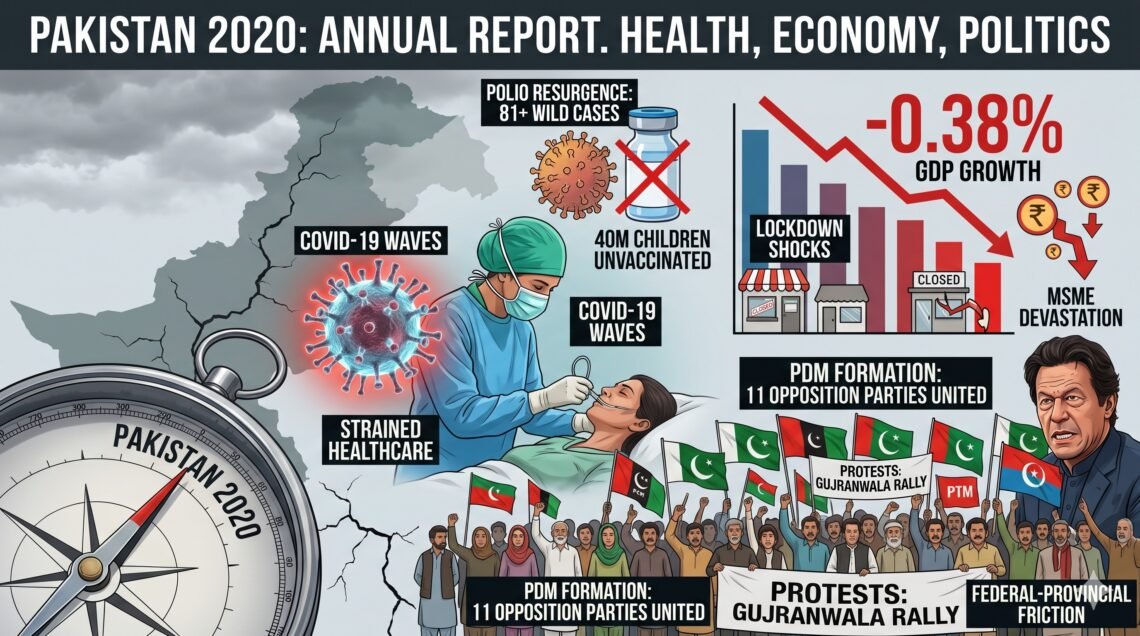
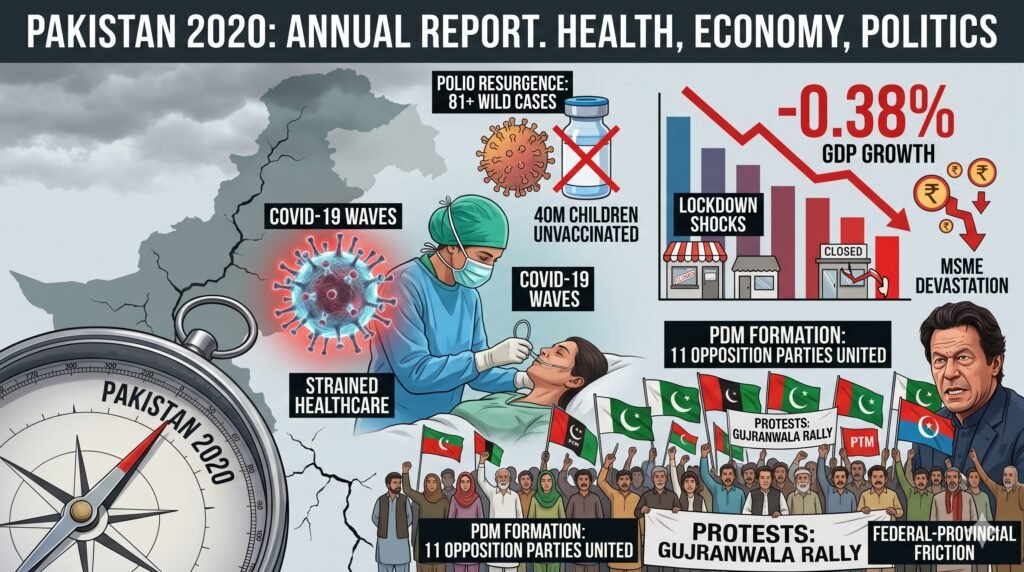
- The Birth of the PDM (Pakistan Democratic Movement): The political climax of the year arrived on September 20, 2020. Driven by public frustration over severe inflation and alleging military interference in civilian governance, 11 major opposition parties—including the PML-N and the PPP—united under a single banner to form the PDM. Led by Maulana Fazlur Rehman, the alliance launched a aggressive multi-phased protest plan. Their inaugural rally in Gujranwala on October 16 drew crowds of tens of thousands, shifting the political dynamic into active resistance for the remainder of the year.
- Province-Center Friction: The managing of the emerging health crisis sparked an intense political rift between the federal administration and the opposition-led provincial government of Sindh. Constant disagreements over structural lockdown parameters exposed severe gaps in national cohesion and governance alignment.
2. Economy Sector: Deep Contraction and Lockdown Shocks
Pakistan’s economy entered 2020 already burdened by weak macroeconomic indicators and structural vulnerabilities. The global pandemic shock pushed the country into a historic downturn.
- Negative GDP Growth: The unexpected arrival of COVID-19 completely erased the initial annual projection of ~3% growth, dragging Pakistan’s real GDP growth rate down into negative territory at -0.38% for the fiscal year.
- Industrial and Business Halts: Following the implementation of a rigorous countrywide lockdown from March 23 to May 9, manufacturing lines ground to an absolute halt. The manufacturing and industrial sectors suffered deep contractions during the first half of the year, crippling industrial exports.
- SME Devastation and Job Losses: Micro, Small, and Medium Enterprises (MSMEs), which operate heavily within the cash economy, were the hardest hit. Severe supply chain disruptions, reduced retail transactions, and tanking consumer demand left nearly two-thirds of small businesses struggling for survival. This economic squeeze ultimately cost the livelihoods of an estimated 3 to 4 million workers.
- External Sector Adjustments: In an effort to counter the shrinking economy and tap into external capital, the federal government launched the “Roshan Digital Account” on September 10, 2020. This digital initiative allowed overseas Pakistanis to channel foreign currency directly back into the domestic banking network, helping prop up fragile state reserves.
3. Health Sector: Pandemic Emergencies and the Resurgence of Polio
The healthcare system faced an unprecedented dual emergency, managing a brand new respiratory pandemic while inadvertently dropping the ball on long-standing eradication efforts.
- COVID-19 Timeline and Waves: Pakistan registered its first two official cases of COVID-19 on February 26, 2020, tracing back to individuals who had recently traveled to Iran. To balance lives and livelihoods, the federal government pivoted from strict nationwide isolation to a localized “smart lockdown” strategy in May. Infections spiked massively around mid-year following Eid festivities but surprisingly flattened between July and October, keeping test positivity rates below 2%. However, a anticipated second winter wave started climbing late in the year.
- The Polio Resurgence Crisis: To divert all available financial and human resources toward combating COVID-19, the Global Polio Eradication Initiative (GPEI) formally suspended mass immunization operations between April and August. This pause left over 40 million children unvaccinated. The vacuum resulted in a severe resurgence of polio cases across vulnerable populations, with Pakistan recording 81–84 Wild Poliovirus cases alongside an alarming 135 cases of vaccine-derived poliovirus by the end of the year.
- Structural Strain: The health sector’s existing gaps—such as severe regional disparities in basic immunization coverage and a lack of early diagnostic testing kits—were heavily exposed. To cope, the polio surveillance workforce was fundamentally integrated as the tracking backbone for the country’s national COVID-19 response data.
Geo News COVID-19 Special Report
This archival broadcast captures the early on-the-ground chaos, lockdown updates, and healthcare strains felt across major urban centers in Pakistan during the first weeks of the 2020 pandemic outbreak.