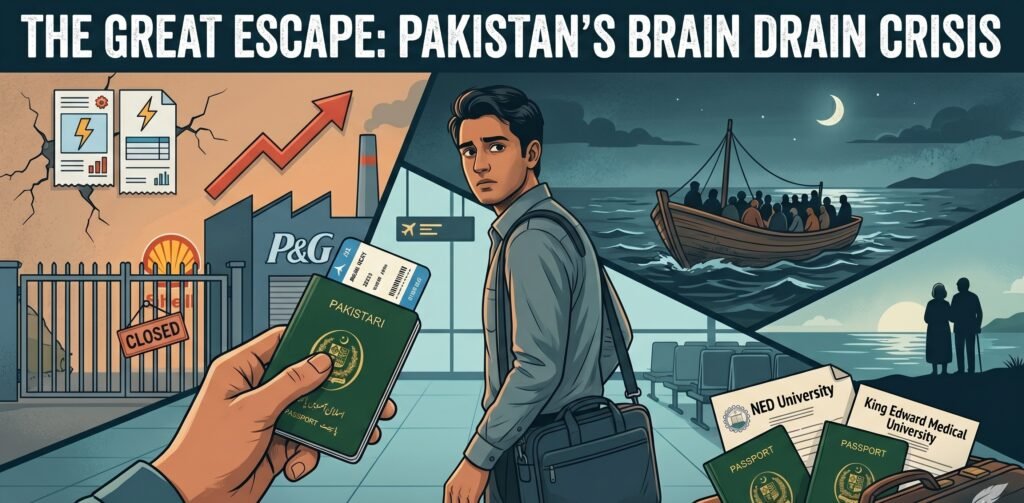
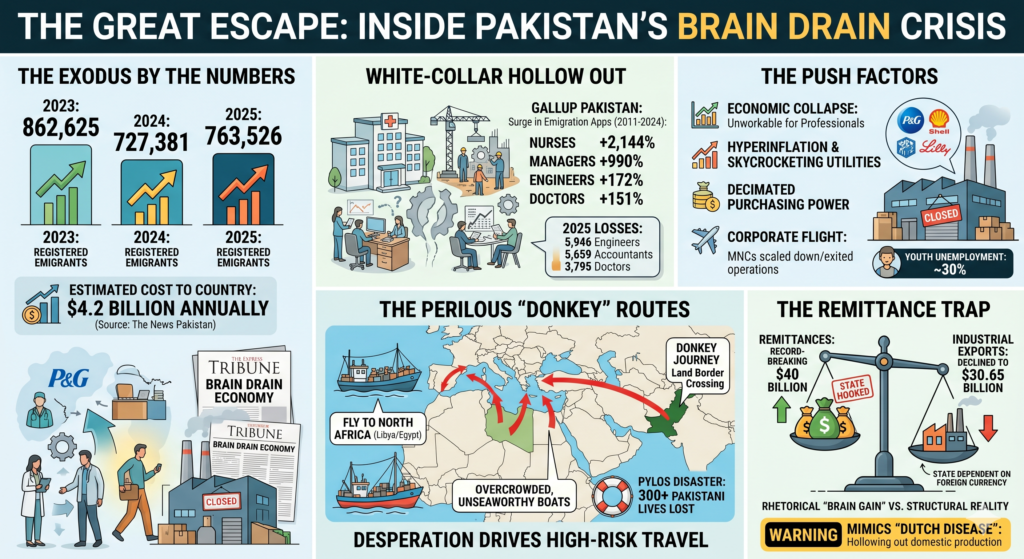
If you’ve scrolled through Pakistani social media over the last couple of years, your feed has likely been flooded with a specific type of photo: a group of smiling, teary-eyed friends standing outside an airport departures terminal, holding a passport and a one-way ticket.It’s a scene playing out across the country every single day. Pakistan is experiencing a historic wave of mass migration. But unlike the labor booms of the 1970s and 80s, this isn’t just about people looking for a temporary gig abroad. It’s a structural flight of capital, intellect, and hope.Let’s break down what’s actually happening on the ground, backed by recent data and investigative news reports.The Hard Numbers: The Exodus by the MillionsThis isn’t an exaggeration or a temporary blip. According to official data from the Bureau of Emigration and Overseas Employment (BEOE), the sheer volume of citizens leaving the country has reached staggering heights:YearRegistered Emigrants Leaving Pakistan2023862,625 (A massive post-pandemic spike)2024727,381 (Sustained despite tightening global visa rules)2025763,526 (A 5% year-on-year increase from 2024)Reports from The News Pakistan estimate that this massive, ongoing flight costs the country roughly $4.2 billion annually in lost economic productivity and foregone tax revenues.The “White-Collar” Hollow OutThe most alarming part of this crisis isn’t just how many people are leaving, but who is leaving. Pakistan’s middle class and intellectual core are packing their bags.A long-term analysis by Gallup Pakistan revealed a terrifying trend in emigration applications between 2011 and 2024. Take a look at how the desire to leave has surged across critical sectors:Nurses: Up an extraordinary 2,144%Managers: Up 990%Engineers: Up 172%Doctors: Up 151%In 2025 alone, the country lost 5,946 engineers, 5,659 accountants, 3,795 doctors, and over 12,700 IT specialists. Media outlets like The Express Tribune have increasingly labeled Pakistan a “Brain Drain Economy.” When a country exports its doctors and software engineers en masse, its hospitals, tech startups, and universities face severe, long-term institutional strain.The Push Factors: Hyperinflation & Corporate FlightWhy is this happening? It’s simple: the domestic system has become unworkable for the average professional. A toxic mix of skyrocketing utility bills, regressive taxation on the salaried class, and a cratering rupee has decimated local purchasing power.At the same time, the formal corporate sector is shrinking. As detailed in deep-dives by Dawn, global giants like Procter & Gamble, Shell, and Eli Lilly have scaled down or completely exited their Pakistani operations. When major multinational corporations pull out, high-paying formal jobs vanish. With youth unemployment hovering near 30%, young university graduates are realizing that hard work and merit no longer guarantee a stable life at home.The Dark Side: Desperation and “Donkey” RoutesThe desperation is so acute that those who cannot secure legal visas are risking everything on illegal human trafficking networks, locally known as “Donkey” (Danki) journeys.As land borders have tightened, smugglers have shifted to deadly maritime routes. They fly desperate migrants into North Africa (usually Libya or Egypt) before forcing them onto overcrowded, unseaworthy boats headed for southern Europe.The lethality of this route was exposed during the horrific Pylos shipwreck off the coast of Greece. A packed fishing trawler capsized, and international agencies confirmed that over 300 Pakistani nationals drowned in that single disaster. Yet, despite regular crackdowns by Pakistan’s Federal Investigation Agency (FIA), the flow hasn’t stopped.The Remittance Trap: “Brain Gain” or Economic Illusion?There is a fascinating paradox in how the state views this crisis. On one hand, civilian and military leadership often reframe the mass exodus as a “Brain Gain,” arguing that overseas Pakistanis are valuable assets who send home vital foreign currency.Financially, the state is entirely hooked on this money. Remittances hit a record-breaking $40 billion, keeping the country’s economy on life support.The Structural Catch-22: While remittances soared to $40 billion, Pakistan’s actual industrial exports fell to just $30.65 billion.Economists warn this mimics “Dutch Disease.” Relying heavily on cash sent from abroad artificially props up local consumption while the domestic manufacturing, technology, and industrial sectors slowly hollow out. Pakistan is essentially treating its brightest minds as an export commodity—but unlike textiles or crops, once your best brains leave, they rarely come back.
some interesting articles
To explore the data, public sentiment, and shifting economic viewpoints surrounding Pakistan’s migration crisis, you can dive deeper using these verified news reports and research portals:
1. In-Depth News Analysis & Editorial Perspectives
- DAWN Newspaper (Editorial Focus): Read an analysis of the root push-and-pull factors—such as limited domestic career growth and lack of meritocracy—and why building stable employment infrastructure is a critical moral imperative.
- Business Recorder (Economic Data): Review the detailed statistical breakdown from the Economic Survey showing how 727,381 registered workers left the country in 2024, alongside insights into their destination dynamics.
- DAWN Op-Eds (Alternative Policy Angle): Read perspectives arguing that exporting surplus workforce shouldn’t simply be dismissed as a policy failure, but rather viewed as a calculated statecraft response to severe domestic job shortages.
2. Public Sentiment & Sector-Specific Research
- Gallup Pakistan: Review global public opinion tracking data that measures public anxieties about economic competitiveness, net migration impacts, and the social realities of losing citizens to other nations.
- Pakistan Institute of Development Economics (PIDE): Explore an academic research paper highlighting how economic instability severely hollows out key sectors, noting that an estimated 50% to 60% of local medical graduates migrate abroad due to low domestic earnings and long hours.